Imagine a world where your home manages its energy consumption intelligently, adapting to your lifestyle and minimizing your environmental footprint. This is the promise of energy-efficient smart appliances, a rapidly evolving sector blending cutting-edge technology with a commitment to sustainability. These appliances aren’t just about convenience; they represent a significant step towards a more efficient and eco-conscious future, offering both financial and environmental benefits to consumers.
This guide delves into the fascinating intersection of smart technology and energy efficiency, exploring the mechanics behind these innovative devices, their impact on energy consumption, and the user experience they provide. We will examine the various types of energy-efficient smart appliances, their key features, and the potential for substantial energy savings at both the individual and societal levels. We will also look ahead to future trends and innovations in this exciting field.
Smart Appliance Technology and Energy Savings
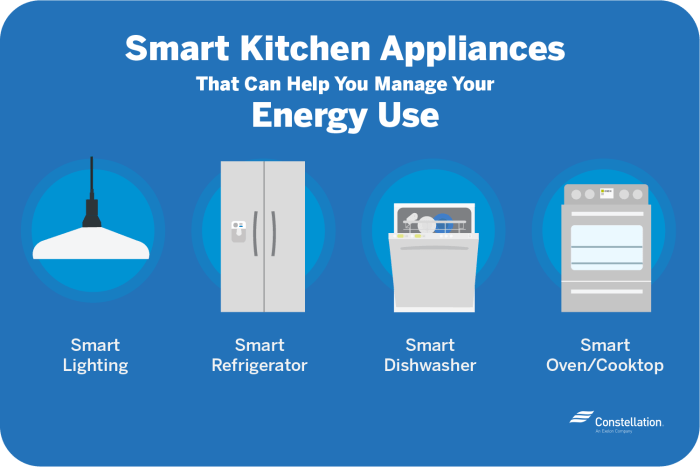
Smart appliances are revolutionizing household energy consumption, offering significant potential for reducing energy waste and lowering utility bills. The integration of smart technology allows for a level of control and optimization previously unavailable, moving beyond simple on/off functionality to dynamic, context-aware energy management.Smart appliances leverage a combination of sensors, connectivity, and sophisticated algorithms to achieve substantial energy savings. Sensors monitor various parameters such as temperature, humidity, and usage patterns, providing real-time data on appliance performance.
This data is then transmitted via Wi-Fi or other network connections to a central hub or cloud service, where algorithms analyze the information and adjust appliance settings accordingly. This dynamic adjustment, based on real-time conditions and predicted needs, is the core of energy-efficient operation.
Energy-Saving Mechanisms in Smart Appliances
Different smart appliance technologies employ varying energy-saving mechanisms. AI-powered optimization, for example, learns user behavior and adapts energy usage accordingly. This might involve pre-heating an oven only when needed based on past usage, or adjusting the refrigerator’s cooling based on ambient temperature and door opening frequency. Remote control functionalities allow users to switch appliances on or off remotely, preventing energy waste from unintentionally left-on devices.
Energy monitoring features provide users with detailed reports on their energy consumption, facilitating informed decisions about usage patterns and potential areas for improvement. A smart washing machine, for instance, might suggest optimal wash cycles based on load size and fabric type, minimizing energy and water usage. In contrast, a non-smart appliance simply operates according to pre-programmed settings, regardless of actual needs or environmental conditions.
This lack of dynamic adjustment often leads to higher energy consumption.
Energy-Saving Modes in Smart Appliances
The following list details various energy-saving modes commonly found in modern smart appliances:
- Eco Mode: This mode prioritizes energy efficiency over speed or performance. Appliances operating in Eco Mode may take longer to complete tasks, but consume significantly less energy. For example, a smart dishwasher in Eco Mode might use a lower water temperature and a longer wash cycle.
- Sleep Mode/Standby Mode: This mode minimizes energy consumption when the appliance is not actively in use. Many smart appliances automatically enter Sleep Mode after a period of inactivity, reducing energy consumption to a near-zero level.
- Smart Scheduling: This feature allows users to schedule appliance operation during off-peak hours when electricity prices are typically lower, reducing overall energy costs. A smart washing machine, for example, could be programmed to run overnight when electricity rates are cheaper.
- Adaptive Learning: Some smart appliances utilize machine learning algorithms to learn user preferences and optimize energy consumption accordingly. For instance, a smart thermostat might learn the occupants’ temperature preferences and adjust accordingly, minimizing heating or cooling when the house is unoccupied.
- Demand Response: This feature allows utility companies to remotely control appliances during peak demand periods, helping to balance the electrical grid and reduce strain on the system. The appliance might temporarily reduce its energy consumption or postpone operation until demand decreases.
The Impact of Smart Appliances on Energy Consumption
The widespread adoption of energy-efficient smart appliances holds significant potential for reducing global energy consumption. These appliances, equipped with advanced sensors and control systems, offer unprecedented opportunities for optimizing energy use in homes and businesses, leading to substantial environmental and economic benefits. Understanding the potential impact requires analyzing both household-level and national-level energy savings projections.Smart appliances offer several avenues for energy reduction.
Many incorporate features like intelligent power management, optimizing energy use based on real-time demand and usage patterns. Others leverage advanced sensors to detect and respond to environmental conditions, further enhancing efficiency. For example, a smart refrigerator can adjust its cooling based on the ambient temperature, while a smart washing machine can optimize its water and energy usage depending on the load size.
These functionalities contribute to a collective reduction in energy consumption, with the potential for substantial savings at both the individual and national levels.
Household-Level Energy Savings Projections
Studies indicate that replacing traditional appliances with their smart, energy-efficient counterparts can lead to significant household energy savings. A typical household might see a reduction in energy consumption ranging from 15% to 30%, depending on the number of smart appliances adopted and their specific energy-saving features. For instance, replacing an old refrigerator with a new energy-efficient smart model can result in annual savings of approximately $50-$100, depending on electricity prices and usage patterns.
These savings can accumulate significantly over the lifespan of the appliance. Furthermore, the integration of smart appliances with home energy management systems can further optimize energy use, leading to even greater savings.
National-Level Energy Savings Projections
Extrapolating household-level savings to a national scale reveals the substantial potential for energy reduction. If a significant portion of households adopts smart appliances, the cumulative effect could translate to a considerable decrease in national energy consumption. While precise projections vary based on factors like adoption rates, appliance types, and regional energy consumption patterns, some studies suggest that widespread smart appliance adoption could reduce national energy demand by 5% to 10% over a decade.
This would have a substantial impact on reducing carbon emissions and mitigating climate change. Consider the case of a country with 20 million households; a 10% reduction in energy consumption translates to the equivalent of powering millions of homes annually.
Hypothetical Scenario: Long-Term Energy Savings
Let’s consider a hypothetical scenario comparing a household using traditional appliances versus a household using smart, energy-efficient appliances over a 10-year period. We’ll assume consistent household size and lifestyle.A line graph illustrating this scenario would show two lines: one representing energy consumption for the household with traditional appliances, and the other for the household with smart appliances. The traditional appliance line would show a relatively flat or slightly increasing trend, reflecting consistent or slightly increasing energy consumption over time.
The smart appliance line would show a noticeably lower starting point and a gradually decreasing trend, reflecting initial savings and further optimization over time due to improved technology and user adaptation. The gap between the two lines would progressively widen over the 10-year period, vividly demonstrating the cumulative energy savings achieved with smart appliances. After 10 years, the smart appliance household would have consumed significantly less energy, showcasing the long-term benefits of investing in energy-efficient smart technology.
The difference in cumulative energy consumption over the decade would be substantial, highlighting the potential of smart appliances to make a significant contribution to energy savings at the household and national level.
User Experience and Behavior with Smart Appliances
The user experience with energy-efficient smart appliances is a crucial factor determining their widespread adoption. A seamless and intuitive interface is essential for maximizing energy savings, while usability challenges can hinder their effectiveness. This section explores the interplay between user experience, behavioral patterns, and the ultimate impact on energy consumption.Smart appliance interfaces are generally designed for ease of use, often incorporating large, clear displays, simple menu navigation, and voice control options.
Many utilize smartphone apps that allow for remote monitoring and control, offering features such as scheduling, customized settings, and energy usage tracking. However, the complexity of these features can vary significantly across brands and models. Some interfaces are exceptionally user-friendly, while others can be confusing or overwhelming for users lacking technological proficiency.
Ease of Use and User Interface Design
Effective user interface (UI) design is paramount. Intuitive icons, clear instructions, and logically organized menus are key to a positive user experience. The ability to quickly understand and utilize the energy-saving features, such as eco-modes or automated scheduling, is directly linked to their effectiveness. Well-designed apps that provide clear visualizations of energy consumption patterns can encourage users to adopt more energy-conscious behaviors.
Conversely, poorly designed interfaces can lead to frustration, reduced usage of energy-saving features, and ultimately, diminished energy savings. For example, an appliance with a complex menu system requiring multiple steps to activate an eco-mode might discourage users from utilizing this feature consistently.
Challenges and Barriers to Adoption
Several factors can hinder the adoption of smart appliances, despite their energy-saving potential. The initial cost of smart appliances is often higher compared to their non-smart counterparts. This price difference can be a significant barrier for budget-conscious consumers. Furthermore, a certain level of technological literacy is required to effectively use and manage smart appliances and their associated apps.
Older individuals or those unfamiliar with smart technology may find the learning curve challenging. Privacy concerns also play a role. Many smart appliances collect data on usage patterns, raising concerns about data security and potential misuse. Addressing these concerns through transparent data policies and robust security measures is essential for building consumer trust.
Impact of User Behavior on Energy Savings
User behavior plays a significant role in determining the effectiveness of energy-saving features in smart appliances. For instance, consistently utilizing eco-modes, setting appropriate temperature levels, and optimizing wash cycles can significantly reduce energy consumption. Scheduling appliances to operate during off-peak hours, a feature facilitated by many smart appliances, can further minimize energy costs. Conversely, neglecting to utilize energy-saving features, leaving appliances running unnecessarily, or overriding automated settings can negate the potential benefits.
A study conducted by the Lawrence Berkeley National Laboratory found that user behavior accounted for a significant portion of the variability in energy savings achieved by smart thermostats, highlighting the importance of user engagement and education. For example, a user who consistently overrides the smart thermostat’s automated settings to maintain a higher temperature will see reduced energy savings compared to a user who allows the system to operate as designed.
Future Trends in Energy-Efficient Smart Appliances
The landscape of energy-efficient smart appliances is rapidly evolving, driven by advancements in technology and a growing global focus on sustainability. We’re moving beyond simple energy monitoring towards appliances that actively learn, adapt, and optimize their energy consumption based on individual usage patterns and real-time grid conditions. This proactive approach promises significant reductions in household energy bills and a considerable decrease in the overall carbon footprint of homes.The integration of increasingly sophisticated technologies is poised to revolutionize how we interact with and benefit from our appliances.
These advancements are not merely incremental improvements; they represent a paradigm shift towards truly intelligent and responsive home energy management.
Energy Harvesting and Self-Powered Appliances
Energy harvesting technologies, such as capturing ambient energy from vibrations, light, or temperature differences, are showing promising potential for powering certain appliance functions or even entire devices. Imagine a refrigerator that partially powers its internal sensors and control systems using energy harvested from the heat generated by its compressor. This could significantly reduce the overall energy draw from the mains power supply.
While currently limited in scale, advancements in materials science and energy conversion techniques are paving the way for more widespread adoption of this technology in the near future. For example, research into piezoelectric materials, which generate electricity from mechanical stress, could lead to appliances that generate power from user interactions, such as opening and closing doors or drawers.
AI-Driven Optimization and Predictive Maintenance
Artificial intelligence (AI) is playing an increasingly crucial role in optimizing the energy efficiency of smart appliances. AI algorithms can analyze usage patterns, predict energy demands, and adjust appliance settings in real-time to minimize energy consumption. For instance, a smart washing machine might learn your laundry habits and automatically select the most energy-efficient wash cycle based on the type and amount of laundry.
Furthermore, AI can also predict potential malfunctions and schedule preventative maintenance, preventing costly repairs and ensuring the appliance continues to operate at peak efficiency. Companies are already incorporating AI into their smart appliances to learn user behavior and optimize energy usage. Examples include smart thermostats that learn user preferences to adjust temperature settings automatically and refrigerators that optimize cooling based on food storage patterns.
Enhanced Integration with Smart Home Ecosystems
The future of energy-efficient smart appliances lies in seamless integration with broader smart home ecosystems. This allows for coordinated energy management across multiple devices, leading to even greater energy savings. For example, a smart home system could coordinate the operation of the dishwasher, washing machine, and dryer to avoid peak energy demand periods, thereby reducing electricity costs and strain on the grid.
Imagine a system that anticipates your arrival home and preheats your oven or adjusts the air conditioning accordingly, based on your preferred settings and your location. This level of integrated control not only optimizes energy use but also enhances convenience and user experience.
Potential Future Features for Energy-Efficient Smart Appliances
The integration of advanced technologies will lead to a range of innovative features in future energy-efficient smart appliances.
- Self-learning energy profiles: Appliances that continuously learn and adapt to individual usage patterns, optimizing energy consumption over time.
- Predictive maintenance alerts: Early warning systems that identify potential malfunctions and schedule preventative maintenance, minimizing downtime and extending the appliance’s lifespan.
- Dynamic load balancing: Appliances that communicate with the smart home system to optimize energy consumption across multiple devices and avoid peak demand periods.
- Integration with renewable energy sources: Appliances that prioritize the use of renewable energy sources, such as solar or wind power, when available.
- Gamified energy saving features: Interactive interfaces that reward users for energy-efficient behavior, encouraging conscious consumption.
- Hyper-efficient motors and compressors: Next-generation motors and compressors that significantly reduce energy consumption compared to current models.
- AI-powered energy forecasting: Appliances that predict energy usage based on weather patterns, household occupancy, and other factors.
Energy-efficient smart appliances are more than just a technological advancement; they are a crucial element in building a sustainable future. By combining intelligent technology with energy-saving features, these appliances offer a compelling pathway to reduced energy consumption and lower utility bills. While challenges remain regarding cost and adoption, the potential benefits are undeniable. As technology continues to evolve and prices become more accessible, the widespread adoption of these appliances promises significant positive impacts on both our individual lives and the environment.
FAQ Section
What is the lifespan of an energy-efficient smart appliance compared to a traditional one?
Lifespans vary by appliance type and brand, but energy-efficient smart appliances generally have comparable lifespans to traditional models. Proper maintenance is key to maximizing their longevity.
Are energy-efficient smart appliances more expensive to repair?
Repair costs can vary. Smart appliances might have more complex components, potentially leading to higher repair costs in some cases. However, many manufacturers offer warranties and extended service plans.
How do I ensure my smart appliance’s security?
Use strong passwords, keep the appliance’s software updated, and be cautious about connecting it to unsecured Wi-Fi networks. Consider using a virtual private network (VPN) for added security.
Do energy-efficient smart appliances require specialized installation?
Most energy-efficient smart appliances can be installed similarly to their traditional counterparts. However, some may require specific wiring or network connections, so consult the manufacturer’s instructions.


